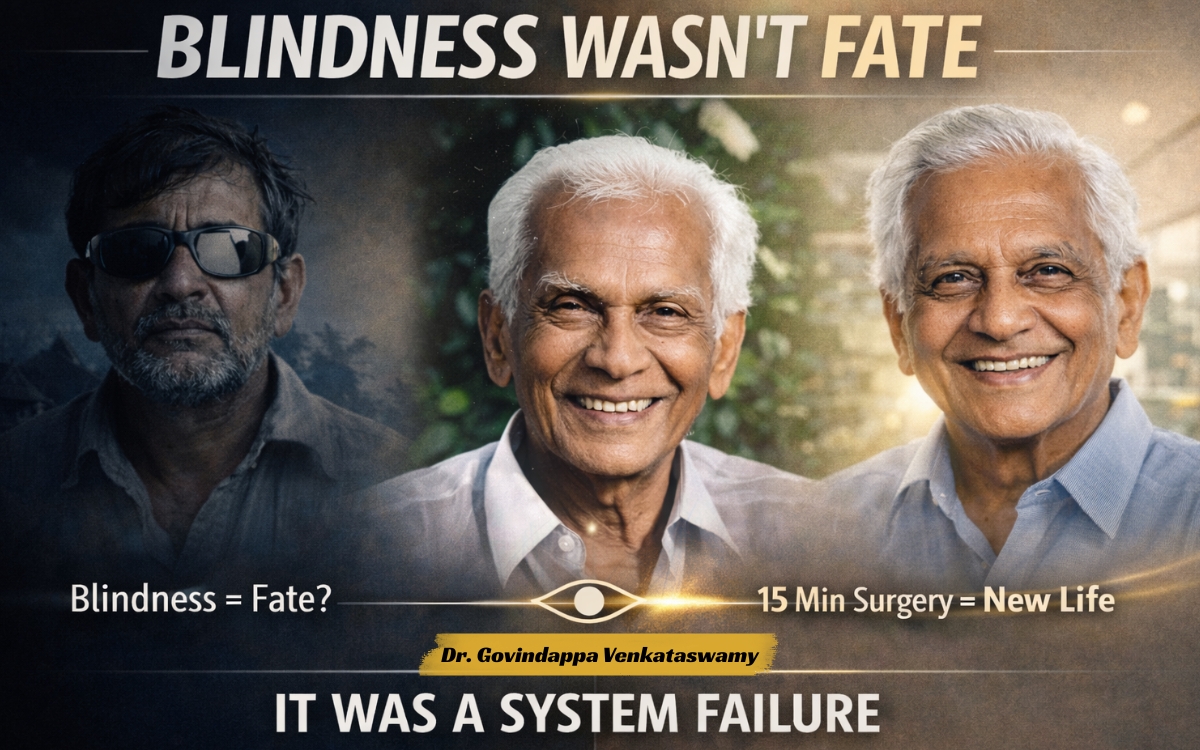
The Day Blindness Became a Life Sentence
And One Man Refused to Accept It
In the villages of Tamil Nadu, blindness did not arrive dramatically. It came slowly. An old farmer would begin to see less. A grandmother would stop recognising faces. A worker would lose his ability to earn.
No one called it a crisis. They called it fate.
Because even though the cure existed, it was out of reach. Hospitals were far. Surgery was expensive. The process was confusing. For millions, especially the poor, losing eyesight meant something irreversible: not just darkness — but dependency, loss of dignity, and silent poverty.
This was India in the 1970s. A country where millions were going blind… for a condition that could be cured in 15 minutes.
The Problem Was Not Medical. It Was Moral.
When Dr. Govindappa Venkataswamy — known as Dr. V — retired from government service, he had seen enough. He had seen people wait for years. He had seen families accept blindness as destiny. He had seen a system that treated care as a service, not a responsibility.
And he asked a question that most people didn't: "If we know how to cure this, why are people still blind?"
The answer was uncomfortable. Because the system was not designed for the poor.
The First Step Was Small. The Vision Was Not.
In 1976, with limited resources, Dr. V started a small eye hospital. No big funding. No large infrastructure. But a very clear belief: No one should remain blind because they cannot afford treatment. That belief was simple. But the problem was massive.
Charity Was Not Enough
Most people would have approached this as charity. Do a few camps. Help a few patients. Move on. Dr. V rejected that approach. Because charity helps a few. But the problem needed a solution for millions.
So he did something unusual. He treated blindness not just as a medical issue — but as a system design problem.
The Breakthrough: Treating Healthcare Like a System
He asked a radical question: What if eye surgery could be done like a well-run system — fast, efficient, and affordable? What followed changed everything.
- Surgeons began performing multiple surgeries in a streamlined flow
- Staff were trained for specialised roles
- Time between surgeries was reduced drastically
The result? The cost of surgery dropped. The number of patients treated increased exponentially. But that was only half the solution.
The Boldest Idea: The Poor Should Not Be Excluded
Dr. V introduced something powerful. Patients who could afford to pay did so. Patients who could not… were treated free of cost. Same doctors. Same quality. Same care. No difference.
The system funded itself. Not through donations. But through design.
Taking the Hospital to the People
But there was still one barrier left. People were not coming to hospitals. So Aravind did the opposite. They went to the people. Eye camps were organised in villages. Thousands were screened. Those who needed surgery were transported to hospitals.
For many, it was the first time someone had come looking for them — not as beneficiaries, but as patients who mattered.
What Changed Was Not Just Vision
Over time, something extraordinary began to happen. People who had lived in darkness started seeing again. A farmer returned to his fields. A grandmother saw her grandchildren. A worker regained his livelihood. Blindness stopped being fate. It became solvable.
How Aravind Was Designed to Solve a Massive Problem
What made Aravind powerful was not just intent. It was design. Dr. V understood something very early: if you treat healthcare like charity, you will help a few. If you design it like a system, you can serve millions.
The Core Design Principle: Scale Lowers Cost
Most hospitals worked like this: fewer surgeries, high cost per patient, limited reach. Aravind reversed the logic.
Surgeons at Aravind perform 2,000-3,000 surgeries per year — far higher than global averages. How?
- Parallel operating tables
- Highly standardised procedures
- Zero idle time between surgeries
Result: cost per surgery drops drastically. Productivity increases without reducing quality. This is not overwork. This is system efficiency.
Division of Labour: Doctors Do Only What Only They Can Do
In most hospitals, doctors do everything — diagnosis, preparation, minor procedures. Aravind redesigned roles.
- Paramedical staff handle routine processes
- Doctors focus only on critical surgical work
This reduces doctor fatigue, increases speed, and improves precision. It is similar to an assembly line — but for healing.
Cross-Subsidy Model: Inclusion Without Charity Dependency
This is one of the most powerful parts of the system. Aravind does not separate patients by quality.
- Paying patients choose private rooms, comfort services
- Non-paying patients receive free care
- Same doctors, same surgery quality, same outcomes
Revenue from paying patients sustains free treatment. Nearly 60-70% patients are treated free or subsidised. This is not donation-based. This is design-based inclusion.
Outreach System: Taking the Hospital to the Invisible
Most hospitals wait. Aravind does not. It goes out.
- Thousands of rural eye camps conducted
- Patients screened in villages
- Transport provided to hospitals
- Surgery done
- Patients sent back with follow-up care
Because the biggest barrier was never surgery. It was reaching the patient.
Vertical Integration: Controlling Cost at the Root
One major cost in eye surgery was intraocular lenses. Imported lenses were expensive. Aravind asked: "Why not make them ourselves?"
They created Aurolab — manufactures lenses at a fraction of global cost, supplies not just India but many countries. This reduced surgery cost globally. This is not just efficiency. This is system control.
Process Discipline: No Randomness
Everything at Aravind is measured, tracked, and improved — from patient flow to infection rates to surgery outcomes. Nothing is left to chance. Healthcare is treated like a precision system.
Culture: Mission Before Institution
Perhaps the most invisible but strongest layer. At Aravind, staff are aligned to a purpose — not just salary-driven work. High discipline combined with high empathy. This creates consistency, trust, and long-term sustainability.
The Scale No One Imagined
From a small beginning, Aravind grew into one of the largest eye care systems in the world. Millions of surgeries. A majority for those who could not pay.
But the real achievement was not numbers. It was this:
- A system that proved compassion can scale
- A model that showed efficiency can serve humanity
- A belief that the poor deserve the same quality as the rich