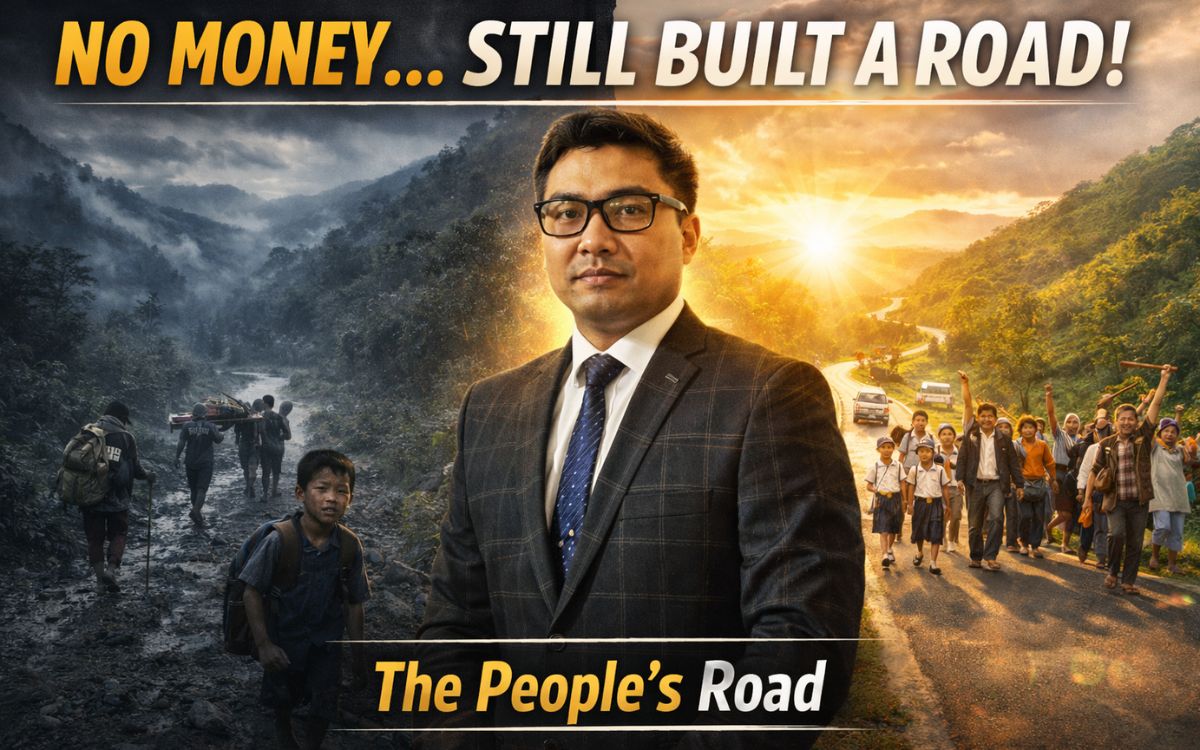
The People's Road: How an IAS Officer and a Community Built Hope in Manipur
When government funding wasn't available, IAS officer Armstrong Pame and citizens across India crowdfunded over 100 kilometres of road connecting isolated Naga villages in Tamenglong, Manipur.
In the remote hill districts of Manipur, connectivity has long been one of the biggest challenges for local communities. Many villages are separated by dense forests, rugged mountains, and poor infrastructure. For years, several Naga villages in Tamenglong district remained almost cut off from the outside world.
There was no proper road connecting these villages to nearby towns. During the monsoon, the muddy tracks became almost impossible to travel. People had to walk for hours, sometimes even days, to reach markets, hospitals, or government offices. For pregnant women, patients, or school-going children, this lack of connectivity often turned into a life-threatening challenge.
For the people living there, development was not an abstract policy concept — it simply meant a road that could connect them to the rest of the world.
When IAS officer Armstrong Pame was posted in the region as a Sub-Divisional Magistrate, he witnessed this reality firsthand. During visits to the villages, he saw how the absence of basic infrastructure was affecting everyday life. Communities were eager to progress, but without connectivity, economic opportunities and essential services remained out of reach.
The most immediate need was clear: a road connecting Tousem subdivision to the rest of the district.
However, there was a major obstacle. The project had no approved government funding. Administrative processes and budget constraints meant that the road might take years to materialize through conventional channels.
Instead of accepting this delay, Armstrong Pame decided to explore a different path. He turned to the people.
Using social media and public outreach, he launched a crowdfunding initiative to build the road. The appeal was simple: if people believed in the importance of connectivity and development in remote areas, they could contribute voluntarily to make the project possible.
The response was extraordinary.
Contributions began arriving from individuals across India and even from Indians living abroad. Ordinary citizens, moved by the story of the isolated villages, donated money to support the effort. At the same time, local villagers themselves contributed through voluntary labour, working together to clear land and build the road.
What followed was a remarkable example of collective problem-solving. Through community participation, local effort, and public contributions, more than 100 kilometers of road were gradually constructed in the remote hills. What once seemed impossible without government funding became a reality through the combined efforts of citizens and administration.
The road transformed the lives of thousands of people in the region. Villages that were once isolated gained easier access to markets, healthcare facilities, and schools. Farmers could transport their produce more easily. Emergency medical travel became possible. The simple act of building a road unlocked new economic and social opportunities for entire communities.
But beyond the physical infrastructure, the project carried a deeper message. It showed that leadership in public service is not only about managing government systems — it is about mobilising society to solve problems together.
Armstrong Pame did not wait for ideal conditions or perfect funding mechanisms. Instead, he believed that if people understood the importance of the problem, they would come forward to solve it collectively.
The road built in Manipur soon became known across the country as the "People's Road."
Its significance lies not just in the kilometers of asphalt laid across the hills, but in the idea it represents: that development can emerge from trust, initiative, and community participation.
In a world where many problems appear too large or too complex to solve, this story reminds us that change often begins with one person asking a simple but powerful question: If the system cannot act immediately, what can we do together?
That question lies at the heart of "I Am the Solution."