The Uniform That Changed the Conversation
A story of social policing, student power, and one man's quiet revolution — how P. Vijayan's Student Police Cadet programme transformed youth-police relations across India.
In most places, the relationship between young people and the police is shaped by suspicion or silence. The uniform arrives after something has gone wrong. But P. Vijayan asked a different question: What if we introduced the police — not as enforcers — but as mentors, guides, and friends? Not after the crime, but before the confusion. Not through force, but through learning. Not when you're in trouble, but when you're still full of potential.
The Challenge: A Gap as Wide as Trust
In most parts of India, the first time a child interacts with a police officer is after something has gone wrong. A theft. A fight. A tragedy. The message is clear and often unspoken: The police are to be feared, not approached.
This fear deepens in marginalized communities, where uniforms are symbols of power — rarely of protection. There was no structured platform for positive engagement between youth and the police. No early trust, no empathy, no shared understanding. As a result, the uniform arrived late — when conflict had already happened. By then, it was too late to educate. All that remained was enforcement.
The Birth of a Cadet Movement
In 2006, while posted in Thrissur, Vijayan began a quiet experiment. He introduced students to the real world of policing — not through lectures, but through experience. No weapons. No power games. Just values, responsibility, and service.
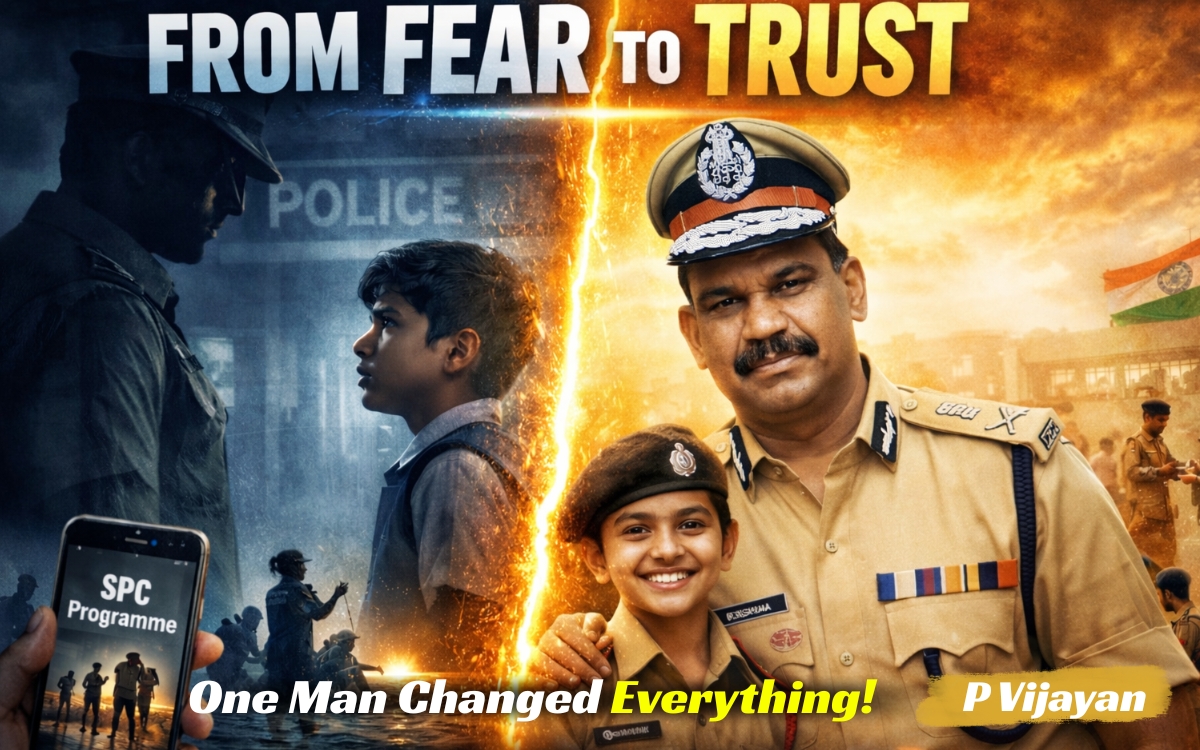
By 2010, this seed became a state-wide programme. The Student Police Cadet (SPC) was officially born. It started with just 127 schools and 11,000 cadets. Today, it's spread to over 12,000 schools in 15+ states, impacting over 9 lakh students. UNICEF came onboard. Other states followed. Even international agencies took note. But the biggest change wasn't in the numbers. It was in the mindset.
Khaki Became a Language of Trust
Wearing the cadet uniform meant more than drills or discipline. It became a symbol of shared responsibility. Cadets led traffic management at public events, tree plantation drives and waste cleanup missions, awareness campaigns on cyber safety, drugs, child rights, and gender equity, and disaster relief operations during floods and fires.
Children who once feared the system became bridges to it. In many cases, they helped change how their families viewed the police.
What They Wore, They Became
The khaki cadet uniform wasn't about power. It was about purpose. Cadets learned traffic control, environmental protection, disaster response, first aid, cyber safety, and human rights. But more importantly, they learned to lead — with compassion, not coercion.
In flood-hit villages, it was cadets who helped elderly citizens evacuate. At large public gatherings, it was cadets who managed crowd discipline. In classrooms, it was cadets who started conversations on gender, drugs, and rights. These weren't assignments. These were awakenings.
When the World Noticed
Other states took note. Gujarat adopted the SPC model. Soon, Tamil Nadu, Andhra Pradesh, Maharashtra, and more joined in. Today, more than 9 lakh students across 12 states have been trained under SPC. Even UNICEF came on board, designating SPC cadets as Child Rights Ambassadors — a global nod to a grassroots Indian innovation.
And yet, despite its scale, the heart of SPC remains intact: Empower before you enforce. Teach before you police. Lead by example.
More Than a Programme — A Cultural Shift
Ask a cadet what SPC means to them, and you won't get a textbook answer. You'll hear stories: Of standing up to a bully, not with fists, but with resolve. Of convincing a parent to stop burning plastic waste. Of explaining cyber safety to a cousin who almost clicked the wrong link. Of learning that being powerful is different from being feared.
Through Vijayan's vision, an entire generation was not just told what to do — they were shown how to lead.
The Man Who Didn't Just Rise — He Uplifted
Before he wore the stars of a police officer, he carried bricks as a daily wage worker. In the dusty lanes of Kozhikode, a young boy walked barefoot to work sites by day and studied under streetlights by night. No one expected him to make it to the civil services. But he did.
And when he entered the Indian Police Service, P. Vijayan didn't just cross a personal milestone — he carried a mission with him. He didn't want to command fear. He wanted to build trust. And for that, he needed to start where fear is first taught — in childhood.
P. Vijayan didn't build an institution. He built a civic conscience — one student at a time. From the construction sites of Kozhikode to the corridors of IPS, he knew what it meant to be unheard. So he made it his mission to ensure no child felt unseen. No community felt left out. No system remained unapproachable.
This is not the story of a civil servant. It is the story of what happens when service meets empathy, and leadership meets humility. The uniform became a message. The cadets became a movement. And the fear of authority gave way to the power of participation. Because someone asked: "What if we stopped waiting for the future to change, and instead — started preparing it?"