The IAS Who Brought Back the Playground
When playgrounds disappeared from one of India's fastest-growing cities, an IAS officer found a way to bring them back — not by building new ones, but by reimagining the spaces that already existed.
In many Indian cities, childhood is quietly losing its most important space — the playground.
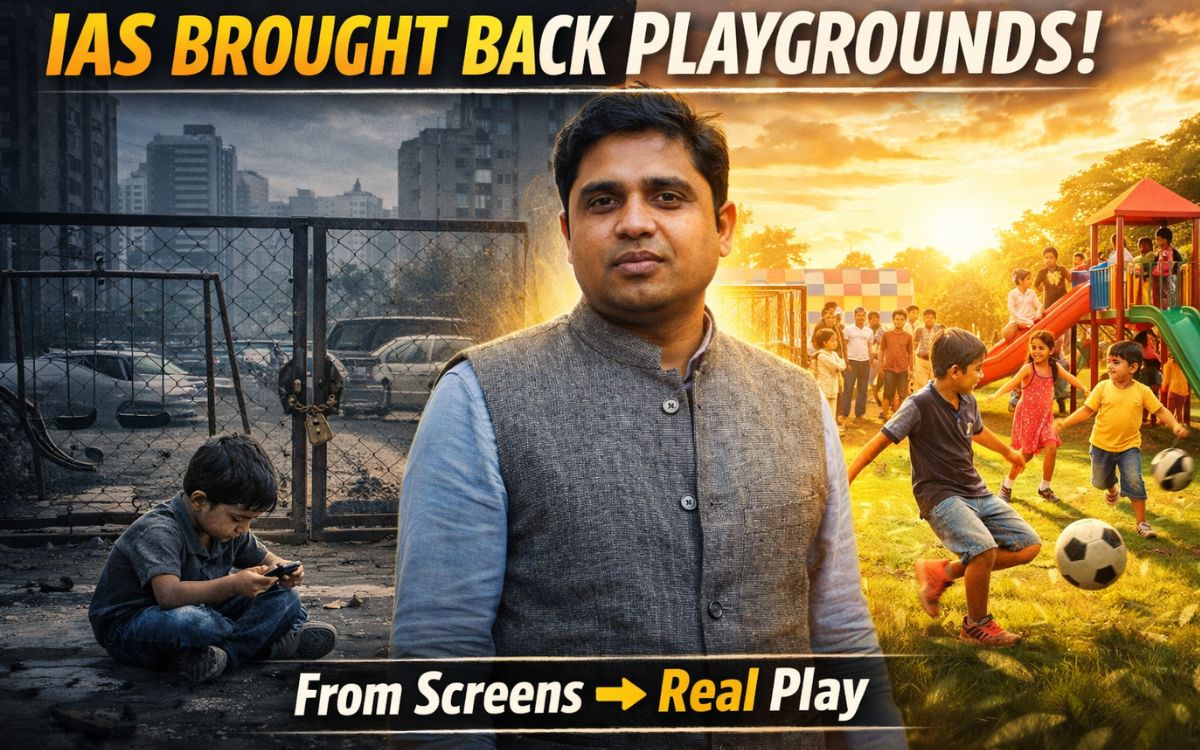
Rapid urbanisation has transformed open spaces into buildings, parking lots, and commercial complexes. For children growing up in cities, safe and accessible playgrounds are becoming rare. Instead of playing outdoors, many children now spend most of their time indoors, often with screens replacing physical activity.
This was the situation in Surat, Gujarat, one of India's fastest-growing cities. As the city expanded rapidly, residential colonies became denser, traffic increased, and open spaces for children began disappearing. Many school grounds remained locked after school hours, and public playgrounds were too few for the growing population.
Children had energy, curiosity, and enthusiasm — but they lacked space.
This was the challenge that IAS officer Banchha Nidhi Pani, serving in the Surat Municipal Corporation, decided to address. He believed that playgrounds are not just spaces for recreation; they are essential for healthy childhood, physical fitness, and social development. Without play, childhood becomes incomplete. Yet creating new playgrounds in crowded cities is difficult because land is scarce and expensive.
Instead of searching for new land, he looked at a simple question: What if the city could use the spaces it already had?
The idea that emerged was both simple and transformative. Many school playgrounds and public institutional grounds remained unused after school hours. If these spaces could be opened to neighbourhood children in the evenings, cities could suddenly create dozens of accessible play areas without acquiring new land.
With this thinking, the administration launched an initiative to reclaim urban spaces for children's play. Schools and local institutions were encouraged to open their playgrounds for community use after school hours. The municipal corporation worked with local communities to ensure safety, basic maintenance, and structured access to these spaces.
Gradually, children who once had nowhere to play began returning to playgrounds. Evenings that were earlier dominated by traffic and noise began to include the sounds of children running, laughing, and playing games.
The initiative was not just about sports — it was about restoring the culture of play in urban life.
Parents welcomed the move because it gave children safe spaces to spend time outdoors. Communities began to interact more as neighbourhood playgrounds became gathering spaces. Schools also benefited as their infrastructure served a broader social purpose.
In a city struggling with urban congestion and shrinking open spaces, the initiative showed that creative governance can solve complex urban challenges without massive investments. Sometimes the solution lies not in building something new but in reimagining how existing resources can serve the community better.
The effort demonstrated how a public official, by observing a simple but important problem, can trigger meaningful social change. It also showed that governance works best when it focuses on improving everyday life for citizens.
By bringing back the playground, the initiative brought back something even more important — the joy of childhood.
In an era where cities often grow without considering the needs of children, this effort sent a powerful message: A good city is not only one that builds roads and buildings. A good city is one where children still have space to play.
This story reflects the spirit of "I Am the Solution." Instead of accepting the disappearance of playgrounds as inevitable, someone chose to ask a different question — How can we bring them back?