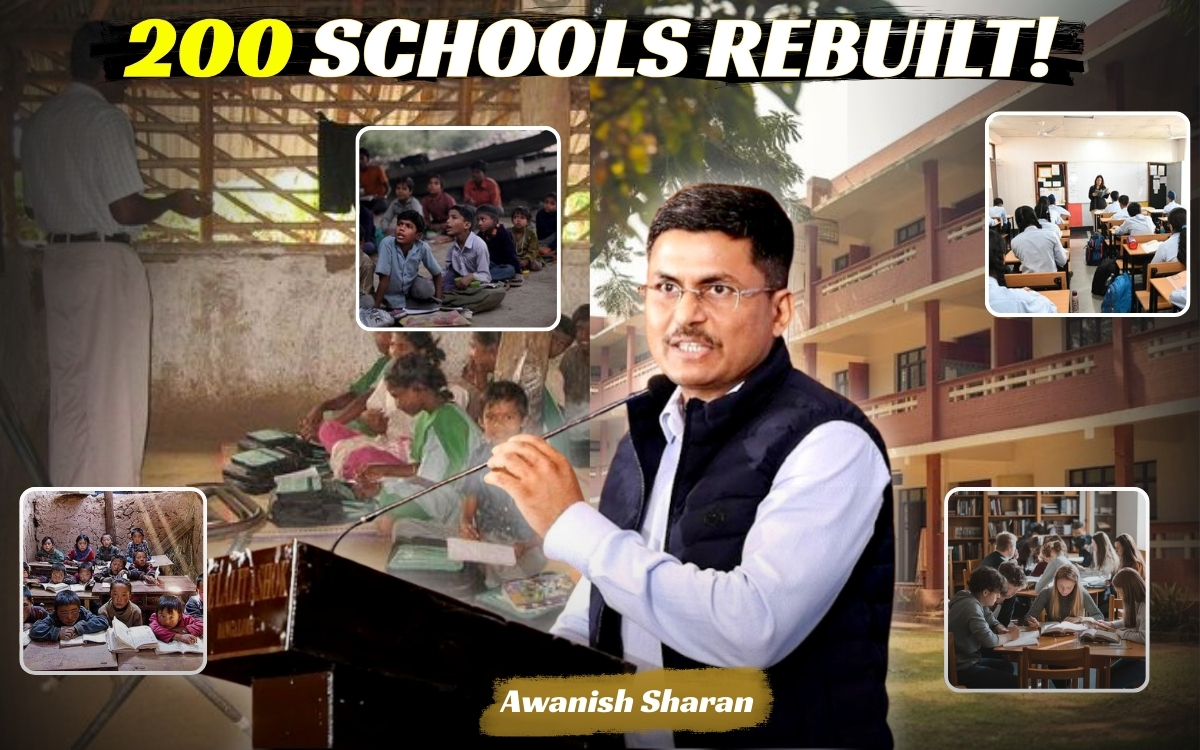
When Schools Were Falling Apart — A District Chose to Rebuild Them
Awanish Sharan and the community-led school transformation in Chhattisgarh — how citizen participation and administrative leadership rebuilt 200 government schools.
In many remote districts of India, the biggest barrier to quality education is not the lack of policies — it is the condition of schools themselves.
This was the reality in several parts of Chhattisgarh, where government schools in rural and tribal areas had slowly deteriorated over the years. Many school buildings were poorly maintained, classrooms were damaged, and basic facilities such as toilets, playgrounds, and learning spaces were either inadequate or missing.
For children growing up in these regions, school often felt uninspiring and uncomfortable. Some classrooms had broken roofs or cracked walls. Furniture was insufficient. Libraries and learning resources were limited. In many places, the physical environment of the school itself discouraged attendance and enthusiasm for learning.
The problem had developed gradually over time. Government systems were often stretched across multiple priorities — roads, health, welfare schemes, and infrastructure. School repairs required funds, approvals, and administrative processes that could take years. As a result, many schools continued to function in poor conditions despite the best intentions of teachers and administrators.
The consequences were serious. When the learning environment is weak, students lose interest in school. Parents begin to doubt the value of government education. Dropout rates increase, and the gap between public and private education widens further.
When IAS officer Awanish Sharan began working in the district administration in Chhattisgarh, he noticed this reality during field visits. Schools that should have been centres of learning were often struggling just to function.
But he also noticed something important.
Even though the schools were struggling, communities deeply cared about their children's education. Parents wanted better schools. Former students wanted their alma mater to improve. Local citizens were willing to help if they felt that their efforts would truly make a difference.
This insight led to a powerful idea. Instead of waiting only for government budgets, the administration began encouraging community participation and citizen contributions to rebuild schools. Through outreach and engagement with local communities, alumni, and well-wishers, people were invited to support the transformation of government schools.
The initiative was not just about fundraising — it was about building ownership.
Citizens contributed money, materials, and voluntary effort to improve school infrastructure. At the same time, the administration closely monitored the work to ensure transparency and effective use of resources. Schools that had once been neglected began to see renovation, new classrooms, better facilities, and improved learning environments.
Awanish Sharan himself remained personally involved in motivating communities, visiting schools, and encouraging people to participate in the effort.
The results were remarkable. Over time, around 200 government schools were rebuilt or significantly improved through citizen support and administrative leadership. Classrooms became brighter and more functional. Infrastructure improved. Learning spaces became welcoming and motivating for students.
The transformation had a powerful psychological effect. Students felt proud of their schools. Teachers felt more motivated to teach. Parents regained confidence in government education. Communities began to see schools not as distant government institutions but as shared assets that belonged to everyone.
What made this effort special was not just the number of schools rebuilt, but the model of partnership it created between citizens and governance. The initiative showed that when people feel connected to a cause — especially something as meaningful as education — they are willing to step forward and contribute.
By combining administrative leadership with community participation, the initiative demonstrated that public education can be strengthened not only through policy but through collective responsibility.
The story of these transformed schools reminds us that the future of a nation is shaped in its classrooms. And when those classrooms improve, the impact reaches generations.
Instead of waiting for someone else to fix the system, communities and leadership came together to say: "These are our schools. We will rebuild them."
That spirit is at the heart of "I Am the Solution."