When Money Meant Freedom: How One Initiative Transformed Women's Financial Power in Bastar
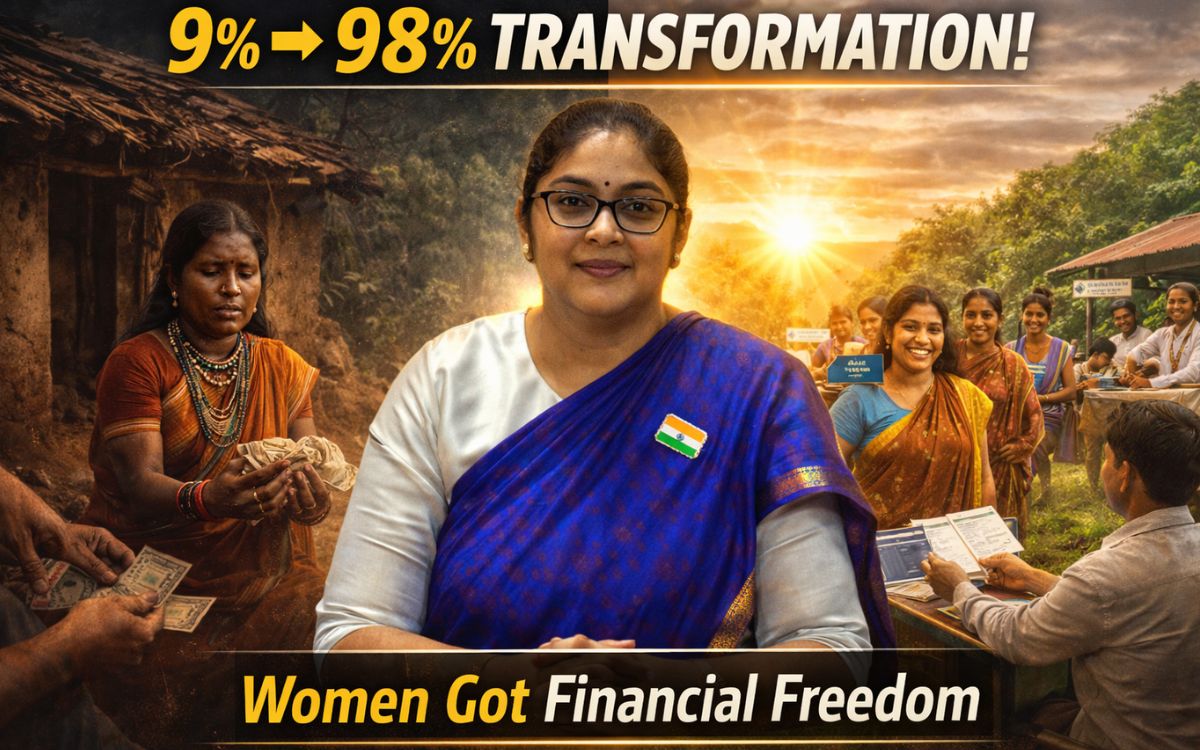
Harshika Singh and the financial inclusion revolution — how tribal women's bank account ownership went from 9% to 98% in one of India's most challenging regions.
Deep inside the forested region of Bastar in Chhattisgarh, development challenges often look very different from those in India's cities. Bastar is home to a large tribal population spread across remote villages, many of which are separated by dense forests and difficult terrain. For decades, the region has struggled with poverty, limited access to formal institutions, and deep mistrust of government systems.
One of the least visible but most powerful forms of exclusion in the region was financial exclusion, especially among tribal women.
In many villages, women had no bank accounts of their own. Money was rarely handled through formal financial institutions. Government welfare schemes existed, but accessing them required banking access that most women simply did not have. Payments were often routed through intermediaries or male members of the household, reducing transparency and limiting women's financial independence.
The numbers revealed the scale of the challenge. In several parts of Bastar, only around 9 percent of tribal women had their own bank accounts. This meant that more than 90 percent of women were completely outside the formal financial system.
The consequences were profound. Without bank accounts, women could not receive direct benefit transfers from government schemes. They had little control over household finances, limited access to savings mechanisms, and almost no connection with formal credit systems. Economic empowerment remained a distant dream.
But the challenge went deeper than infrastructure. Many women had never visited a bank. Some villages were located far from banking facilities. Language barriers, lack of financial literacy, and historical mistrust of formal institutions made the system feel distant and intimidating.
When IAS officer Harshika Singh began working in the region, she recognised that financial inclusion was not just a technical issue — it was a question of trust, access, and empowerment.
Opening bank accounts required much more than paperwork. It required building confidence among women who had long been excluded from the financial system.
The initiative began with a focused effort to bring banking closer to the villages. Administrative teams worked closely with banks, local governance institutions, and community networks to make the process accessible. Camps were organised in villages where women could open bank accounts without having to travel long distances.
At the same time, awareness campaigns were launched to explain why having a bank account mattered. Women were encouraged to understand how accounts could help them receive government benefits directly, save money securely, and participate more actively in household financial decisions.
Community engagement became a crucial part of the effort. Local leaders, self-help groups, and grassroots workers helped bridge the trust gap between formal institutions and tribal communities.
Gradually, the momentum began to build. Women who had never interacted with banks before started opening accounts in large numbers. Once the process became familiar and accessible, participation increased rapidly.
The results were transformative. Within a relatively short period, the percentage of tribal women in Bastar with their own bank accounts increased from around 9 percent to nearly 98 percent. What had once been a rare exception became the new normal.
But the most powerful impact was not simply the number of accounts opened.
For the first time, thousands of women gained direct access to financial systems. Government benefits began reaching them directly through bank transfers. Women started saving money in their own accounts. Many became active participants in local self-help groups and community economic activities.
Financial inclusion began to translate into greater confidence, independence, and decision-making power.
The initiative demonstrated an important lesson: economic empowerment is not only about income — it is also about control, dignity, and trust in systems.
By connecting tribal women to the banking system, the effort created a pathway for long-term social transformation in one of India's most challenging regions.
The story of Bastar shows that real development often begins with simple but fundamental changes — like ensuring that every woman has access to her own bank account.
And when systems begin to include those who were once excluded, the results can be transformative.
This story reflects the essence of "I Am the Solution." Because sometimes the most powerful solutions are not about building something new — they are about bringing people into systems that were never designed to include them before.