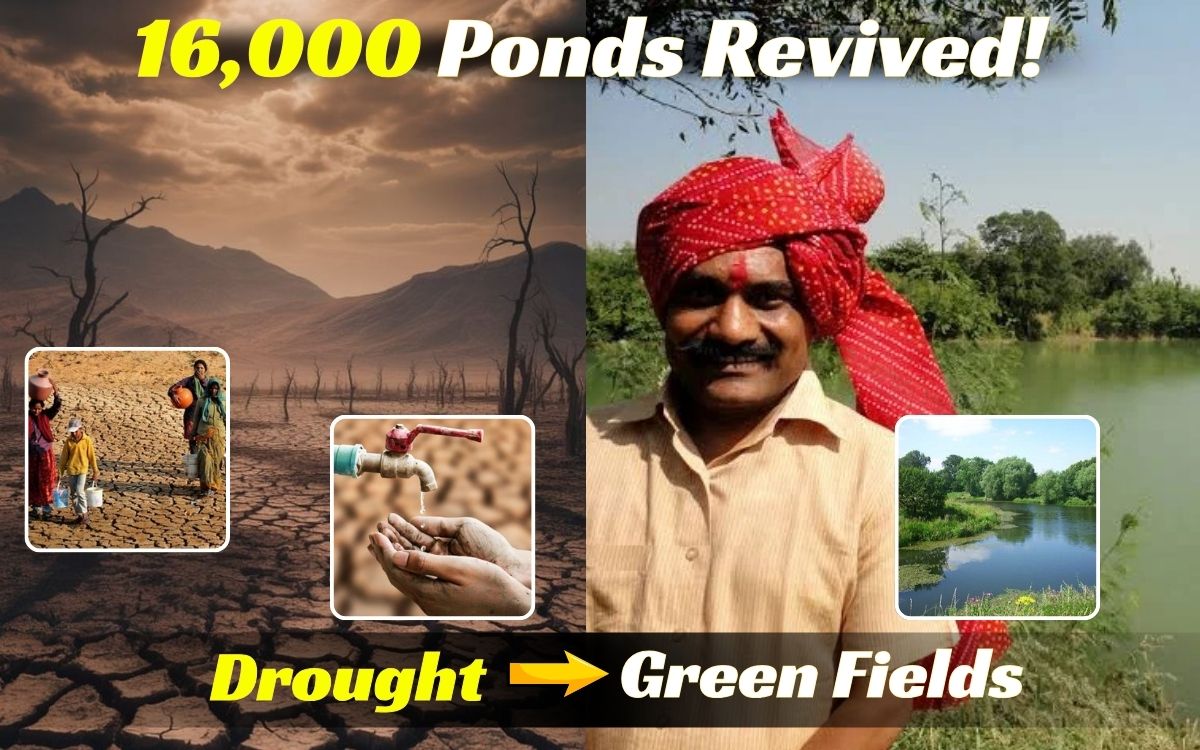
Reviving Water, Reviving Lives: The Pond Revolution in Rural Madhya Pradesh
Umakant Umrao and the power of restoring what was forgotten — how the revival of 16,000+ traditional ponds transformed rural livelihoods and water security across Madhya Pradesh.
Across large parts of rural Madhya Pradesh, water has long determined the fate of agriculture and livelihoods. Many districts face recurring drought-like conditions, erratic rainfall, and declining groundwater levels. Farmers often depend entirely on the monsoon, and when rains fail or arrive late, crops fail with them.
For years, rural communities in several regions struggled with shrinking water sources and deteriorating traditional ponds. Historically, villages across central India depended on thousands of small ponds and water bodies that stored rainwater and supported agriculture. These ponds were once the backbone of local water management systems.
But over time, many of these water bodies fell into neglect.
Encroachment, silt accumulation, lack of maintenance, and changing agricultural practices gradually reduced their capacity. Some ponds dried up completely. Others became shallow and unusable. As these traditional water systems collapsed, groundwater extraction increased and the region became even more vulnerable to drought.
The consequences were severe. Farmers faced declining crop yields. Irrigation became unreliable. Seasonal migration increased as rural livelihoods weakened. Entire communities became trapped in cycles of water scarcity and economic instability.
When IAS officer Umakant Umrao began working in the region, he recognised that the problem was not just about rainfall — it was about the collapse of local water systems that had once sustained rural life.
Instead of searching for expensive new infrastructure projects, he focused on a simple but powerful question: What if the solution already existed in the landscape — but had been forgotten?
Across villages, thousands of traditional ponds still existed, but they were buried under layers of silt, damaged embankments, and years of neglect. If these water bodies could be revived, they could once again store rainwater, recharge groundwater, and support agriculture.
This insight became the foundation of a massive restoration effort.
Under his leadership, the administration launched an initiative to identify, revive, and restore traditional ponds across the region. The work involved removing accumulated silt, repairing embankments, improving water storage capacity, and ensuring that ponds could effectively capture monsoon rainwater.
But the effort was not just a government program. Communities were encouraged to participate actively in the restoration process. Local villagers, farmers, and village institutions worked together to bring these water bodies back to life. The initiative also aligned with rural employment programs, allowing restoration work to generate livelihoods while rebuilding water infrastructure.
The scale of the transformation was extraordinary. Over time, more than 16,000 ponds were revived across different regions. What had once been neglected or forgotten water bodies began filling with rainwater again during the monsoon.
The impact was visible across rural landscapes. Groundwater levels improved as ponds allowed rainwater to percolate into the soil. Farmers gained more reliable access to irrigation. Agriculture became more resilient to unpredictable rainfall patterns. Crop productivity improved, and many farmers began adopting more diversified and sustainable farming practices.
The revival of ponds also supported climate-resilient agriculture — a critical need in an era of changing climate patterns.
But perhaps the most powerful impact was social. Communities began to rediscover the importance of traditional water systems that earlier generations had carefully maintained. Villages that once faced severe water scarcity started seeing the return of reliable local water sources.
The initiative demonstrated that sometimes the most effective solutions are not always about building something entirely new. Sometimes the answer lies in reviving the wisdom and infrastructure that communities once depended upon.
By restoring thousands of ponds, the effort restored something even more valuable — confidence that local resources, when managed wisely, can transform livelihoods.
The story of this pond revival movement shows how thoughtful leadership can turn a forgotten landscape into a resilient future.
Instead of accepting water scarcity as inevitable, the initiative asked a different question: What if we bring our water systems back to life?
That spirit captures the essence of "I Am the Solution."