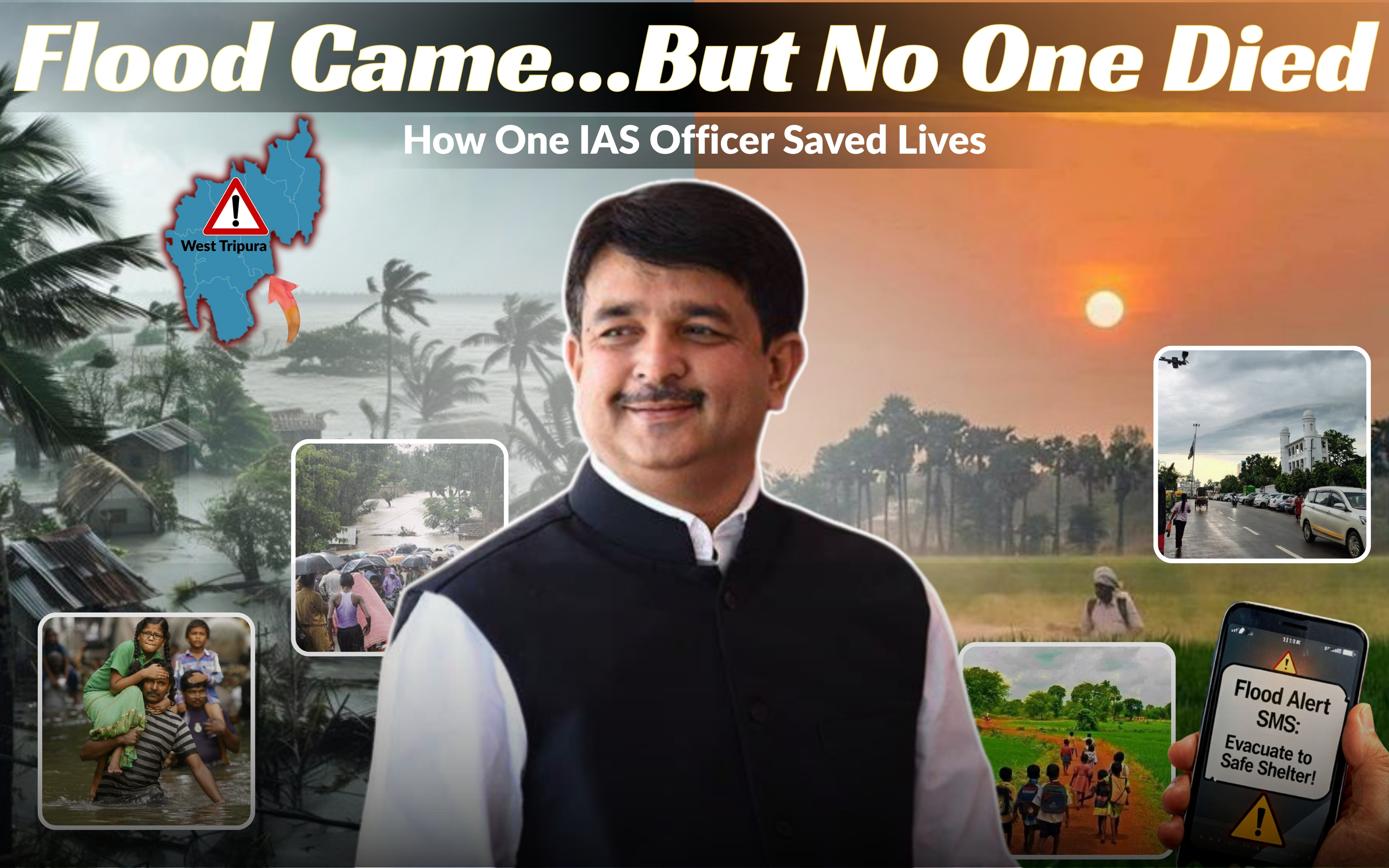
The River That Didn't Drown Us Anymore
How West Tripura turned flood fear into preparedness — a story of leadership, technology, and community trust that saved hundreds of families.
For years, the monsoon in Agartala and the wider West Tripura district carried a familiar sense of fear. When the rains arrived, the rivers would swell quickly. Low-lying villages near riverbanks and drainage channels would begin to flood with little warning. In many cases, people would realize the danger only when water had already entered their homes.
The pattern repeated year after year. Families would scramble to move belongings to higher ground. Children would miss school for days. Livestock would be lost. In some tragic cases, people were swept away by sudden currents during the night or early morning.
Flood warnings often came late or did not reach the most vulnerable communities in time. Weather alerts issued at the state level could not always predict exactly which local areas would flood and when. As a result, floods were treated almost like an unavoidable natural event — something people simply had to endure.
A Different Way to Think About Disaster
When IAS officer Kiran Gitte took charge as the District Magistrate of West Tripura, he saw this problem not only as a natural disaster challenge but as a governance challenge. Floods themselves could not be prevented. But the damage they caused could be dramatically reduced if people received accurate and timely warnings.
The core problem was clear: People were not getting actionable information early enough. If communities could receive alerts hours or even days before danger arrived, they could move to safer areas, secure their belongings, and protect their families. This idea led to a shift from reactive disaster response to predictive preparedness.
Building a Local Flood Intelligence System
Instead of relying only on distant weather forecasts, the district administration began building a localized early-warning system. Rain gauges and river-level monitoring points were installed at critical locations across vulnerable parts of the district. These instruments continuously tracked rainfall intensity and water levels.
The data was fed into a centralized dashboard that allowed district officials to observe changing conditions in real time. Patterns of rising rainfall and river flow could now be detected early, providing crucial hours of preparation time.
But data alone was not enough. The system was designed to immediately translate this information into clear alerts for communities. If rainfall or water levels crossed critical thresholds, automated SMS messages would be sent to village leaders, panchayat members, and local officials.
Turning Technology into Community Action
Technology was only one part of the transformation. The administration invested significant effort in community engagement and training. Local volunteers, frontline workers, and disaster response teams were trained to understand warning signals and respond quickly.
Schools were identified as temporary shelters. Evacuation routes were mapped. Community WhatsApp groups and local communication networks were activated to ensure information spread rapidly.
Kiran Gitte himself visited villages, schools, and tea garden communities to explain how the system worked. These interactions helped build trust in the new approach. People no longer felt that warnings were distant or confusing.
When the Rains Returned
In 2021, a major storm system brought heavy rainfall to Tripura once again. But this time the district was ready. Early alerts were issued nearly three days in advance. Authorities began preparing flood shelters. Public works teams strengthened vulnerable points with sandbags. Local volunteers helped guide families to safer locations.
The results were striking. Despite heavy rains and rising rivers, no lives were lost in the affected areas. Hundreds of families were relocated safely before floodwaters reached their homes. For the first time in years, communities felt something they had never experienced during the monsoon — a sense of control.
A District That Learned to Prepare
The transformation of West Tripura demonstrated a powerful lesson about disaster management. Natural hazards cannot always be avoided. But their human impact can be drastically reduced through information, preparedness, and trust between citizens and administration.
By combining local data systems, early-warning alerts, and community participation, the district moved from a cycle of panic and reaction to a culture of preparedness. The river still rises during the monsoon. But today, people are no longer caught unaware.
Instead of asking how to respond after disaster strikes, the district administration asked a different question: How can we ensure people are ready before the danger arrives? That question turned fear into preparedness. And that is the spirit of "I Am the Solution."