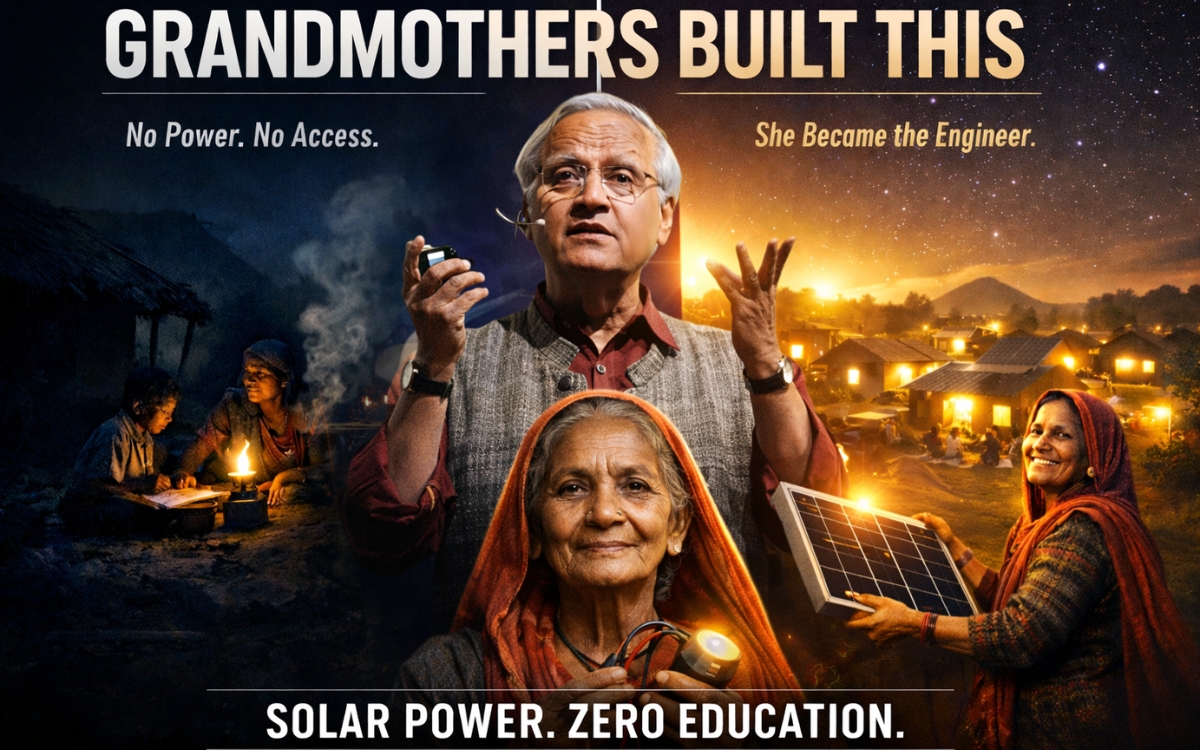
The Village Where Grandmothers Became Engineers
How Barefoot College Turned Illiteracy into Power
In many remote villages across India, darkness did not begin at night. It was always there. When the sun went down, entire villages disappeared into blackness. No electricity. No street lights. No study lamps. No safety.
Children stopped studying after sunset. Women cooked in dim light. Kerosene lamps filled homes with smoke and danger. Everyone knew electricity was the solution. But it never came.
The Problem Was Not Just Power. It Was Access.
Even when solar technology began to emerge, there was another barrier: Who would install it? Who would maintain it? Because the assumption was simple: Technology needs educated people. And in these villages, most people — especially women — were illiterate. So the system concluded: "They cannot do it."
One Man Refused to Agree
When Bunker Roy, the founder of Barefoot College in Tilonia (Rajasthan), saw this reality, he questioned the assumption itself. He understood: People may not read or write. But that does not mean they cannot learn. And solutions should not depend on outsiders. They should come from within the community.
The Turning Point: Rethinking Who Can Be an Engineer
Instead of bringing trained engineers from cities, Barefoot College chose rural women — mostly grandmothers. Women who had never been to school, could not read or write, had never seen technology before. And they said: "You can become solar engineers." It sounded impossible. Even to the villagers.
Learning Without Literacy
The training was unlike anything traditional. No textbooks. No written exams. Everything was taught through:
- Colour codes
- Symbols
- Hands-on practice
Women learned how to assemble solar panels, wire circuits, repair batteries, install lighting systems. Slowly, confidence replaced hesitation. Hands that had never touched tools began building systems.
The First Light
When these women returned to their villages and installed solar lighting systems, something powerful happened. Homes lit up. Children studied at night. Women cooked safely. Villages became more active after sunset. But the real transformation was not the light. It was who brought the light.
From Dependence to Ownership
Earlier villages waited for government or external help. Technology felt distant. Maintenance was impossible. Now the engineer lived in the village. Problems were solved locally. Knowledge stayed within the community. And most importantly — women who were once seen as dependents became problem-solvers.
The Hidden Design Behind Barefoot College
For years, many villages did receive solar panels. Installed by experts. For a few weeks, there was light. Then something small would fail — a wire, a battery, a connection. And the village returned to darkness. Not because the technology failed. But because no one in the village knew how to fix it.
The Real Barrier Was Not Skill
The barrier was not intelligence. The barrier was how learning was designed. So instead of forcing them into classrooms, they changed the system. Training became physical, visual, experiential.
What Changed Was the Design, Not Just the Outcome
Before: Technology came, failed, dependence continued. After: Capability was built, ownership created, solution sustained. The difference was not in solar panels. It was in who controlled the solution.
Why This Model Travels Across the World
This approach did not depend on high education, strong institutions, or large funding. It depended on trust in people, redesign of learning, and local ownership. That is why the same model worked in Africa, Latin America, and other parts of Asia.
Changing More Than Electricity
Barefoot College did not fail where others failed because it did something different. It did not deliver a solution. It built the ability to sustain the solution.
- Women gained respect and identity
- Communities became self-reliant
- Migration reduced
- Confidence spread across villages
In many cases, these "barefoot engineers" even trained others — across India and in countries in Africa and Latin America.