The Day the Earth Shook — And a Potter Lost Everything
How Mitticool Turned Clay into a Lifeline for Rural India
In January 2001, when the Bhuj earthquake struck Gujarat, it did not just destroy buildings. It shattered livelihoods. In villages across Kutch, homes collapsed, markets disappeared, and small artisans lost everything overnight.
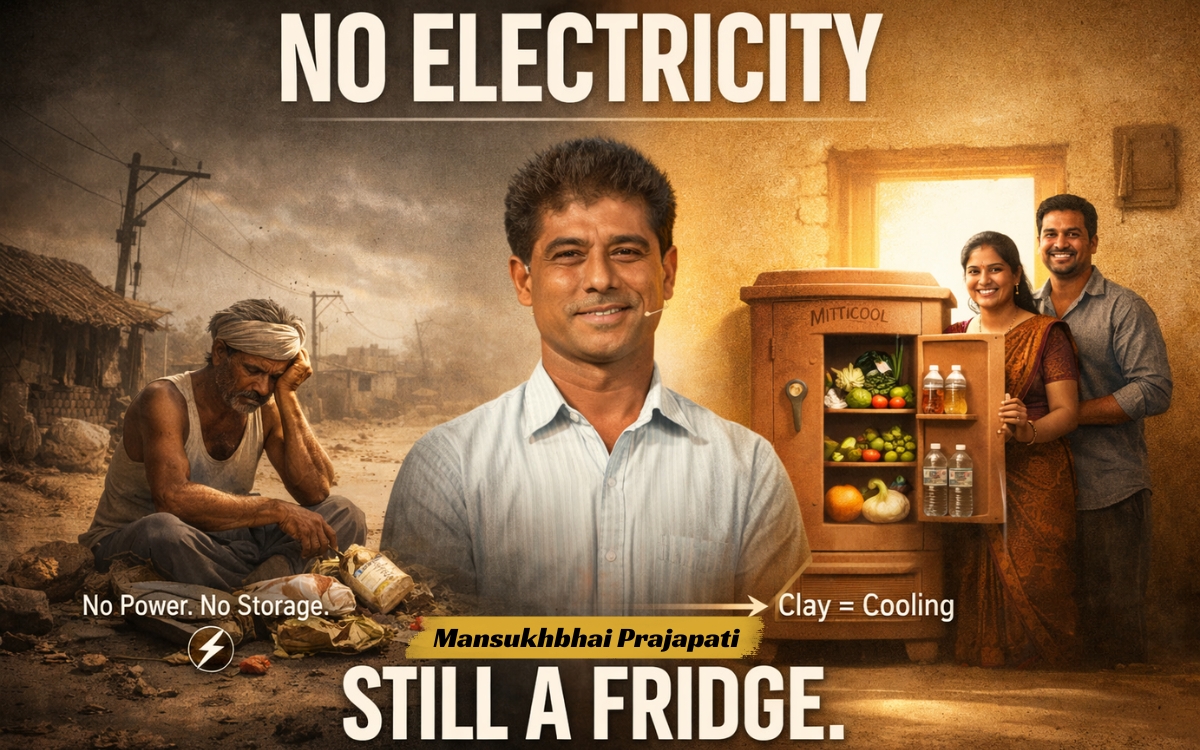
Among them was Mansukhbhai Prajapati, a traditional potter. His kiln was destroyed. His products were buried. Years of work vanished in seconds.
The Problem Was Bigger Than One Man
Even in normal times, life without electricity meant constant struggle. Food spoiled within hours in summer. Milk had to be consumed immediately or wasted. Refrigerators existed. But for millions, they were irrelevant — electricity was unreliable or absent, appliances were expensive, maintenance was not practical.
A Potter's Perspective
Mansukhbhai did not think like an engineer. He thought like someone who had lived with clay all his life. He knew something simple: water stored in earthen pots stays cool. Clay allows slow evaporation. Evaporation creates cooling. But he asked a different question: "If clay can cool water… why not food?"
The Breakthrough: Mitticool
After multiple iterations, he created Mitticool. A clay-based refrigerator that:
- Works without electricity
- Uses natural evaporation for cooling
- Has separate compartments for water and food
- Is affordable and easy to use
The cooling is not like a modern fridge. But it is enough — keep vegetables fresh for days, prevent milk from spoiling, provide cool drinking water.
Why This Problem Never Got Solved
The system had a blind spot. Most innovations assumed electricity is available. So every solution was built on that foundation. But in large parts of rural India, that foundation did not exist. The problem was not lack of technology — the problem was wrong assumptions in design.
The Design Behind Mitticool
Mitticool is not a tech innovation. It is a material behaviour innovation. The design insight was: let material do the work, not machines. Instead of compressors, refrigerants, electrical systems — cooling is achieved through physics already present in nature.
Constraint as Foundation, Not Limitation
Typical design thinking removes constraints. Mitticool accepted constraints as fixed — no electricity, low affordability, rural usage conditions. Instead of solving constraints, he designed within them. This creates robustness, relevance, and adoption.
Behaviour-Compatible Design
Many solutions fail because they demand behaviour change. Mitticool does the opposite. People already use earthen pots. Water storage habits exist. No training required. Adoption friction equals near zero.
Zero Maintenance Architecture
Most systems fail in rural areas due to repair complexity and spare parts. Mitticool eliminates this layer. No wiring, no moving parts, no mechanical systems. Failure probability is extremely low.
Affordability Through Design, Not Subsidy
Most inclusive products rely on subsidies. Mitticool does not. Cost is reduced because raw material is local, manufacturing is simple, no imported components. Affordability is built into the system, not added later.
The Deeper Lesson
Most systems try to solve problems by adding more — more technology, more cost, more complexity. Mitticool did the opposite. It removed dependency on electricity, complexity, cost barriers. And in doing so, it unlocked access.
Mansukhbhai Prajapati did not set out to build a revolutionary product. He set out to solve a problem he had lived with. That made all the difference. The question he asked was not "How do we make a better refrigerator?" It was "How do we keep food fresh… where electricity does not exist?" That shift turned clay into a solution. And that is the essence of "I Am the Solution."